
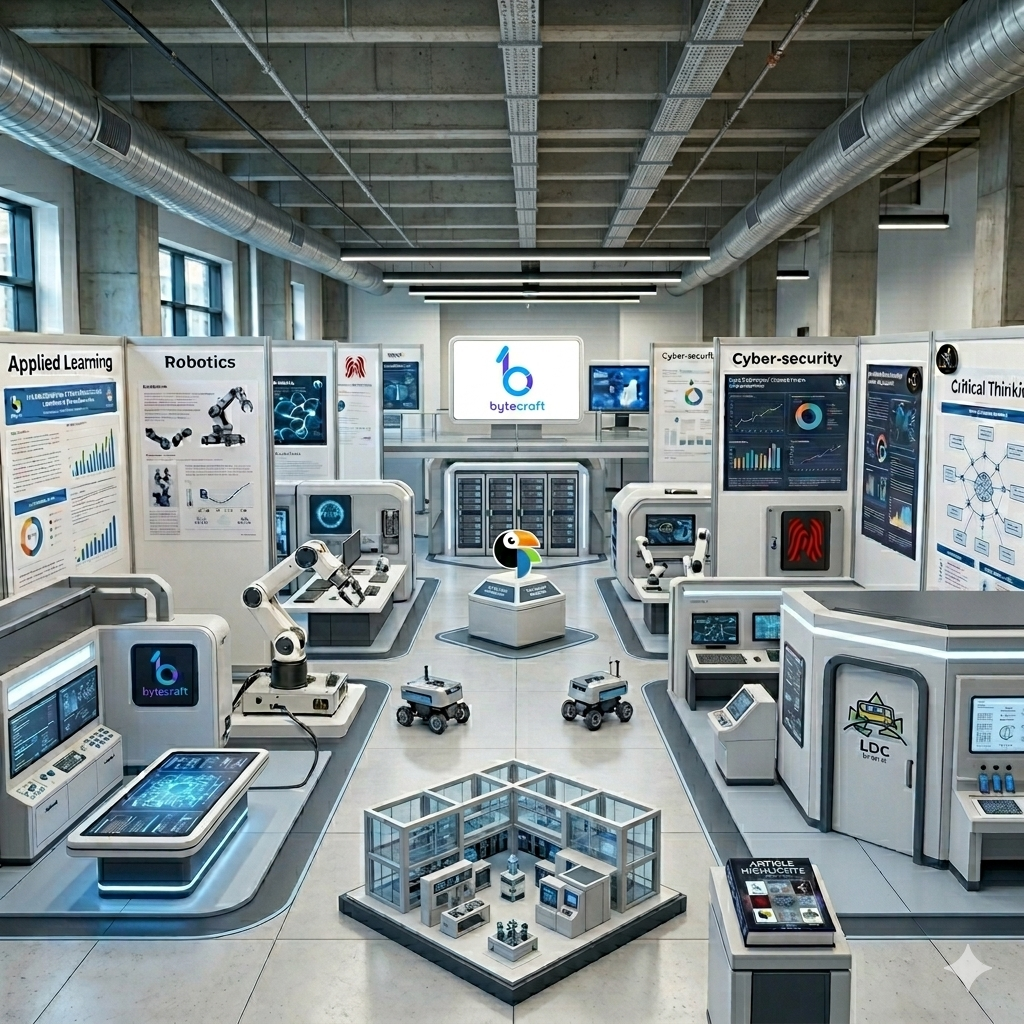
At ESTIN, scientific clubs have become an essential part of student life and professional development. Beyond academics, these clubs provide students with opportunities to apply their knowledge, develop leadership skills, build innovative projects, and contribute to a dynamic technological community.
Learning Beyond the Classroom
Scientific clubs create an environment where students can transform theoretical knowledge into practical experience. Through workshops, competitions, hackathons, and collaborative projects, students strengthen both their technical and interpersonal skills.
These experiences help students develop:
- teamwork,
- communication,
- project management,
- problem-solving abilities,
- creativity,
- and leadership.
Such skills are increasingly important in today’s fast-changing technological world.
Building a Culture of Innovation
Several ESTIN clubs actively contribute to promoting innovation and hands-on learning throughout the 2025/2026 academic year.
The Bytecraft club organized Code Craft 2025, a national programming competition that brought together talented students from universities across Algeria. The club also launched workshops in artificial intelligence, cinematography, and digital skills development, while participating in entrepreneurship-related initiatives and collaborative projects.
More recently, Bytecraft successfully organized InnoByte 2.0, a 72-hour national hackathon focused on cybersecurity and web development challenges. The event gathered students from different universities in an intensive collaborative environment where creativity, teamwork, and problem-solving were placed at the center of the experience. Through this initiative, participants were able to confront real technological challenges while strengthening their practical engineering skills.
In the field of cybersecurity, the Nexus club organized several technical activities designed to immerse students in realistic competitive environments. Among them, NexTrace combined practical cybersecurity workshops with a mini Capture The Flag competition, while NexHunt attracted international participation through an online CTF event bringing together students and cybersecurity enthusiasts from different countries.
The club also launched NEX ZERO, a three-day technology challenge focused on cryptography, ethical hacking, reverse engineering, and web development. The event encouraged participants to work collaboratively while applying technical knowledge to real-world cybersecurity scenarios, reinforcing both strategic thinking and technical expertise.
Leadership and Student Engagement
Scientific clubs also play a major role in strengthening student engagement and leadership.
The RASA club organized cultural and communication-oriented activities that encourage student interaction and personal development. Initiatives such as the Speaking Club helped students improve their English and French communication skills while building confidence in public speaking.
Similarly, LDC contributes to student well-being and community spirit through activities that encourage collaboration, networking, and social interaction among students.
Environmental and Social Impact
Student clubs at ESTIN are also involved in environmental and community initiatives.
The Origo club led several awareness and sustainability activities, including:
- environmental clean-up campaigns,
- tree planting initiatives,
- awareness workshops,
- and collaborations with local associations.
These projects help students develop a stronger sense of responsibility, citizenship, and social impact.
Preparing More Complete Engineers
Today’s technology sector requires more than technical knowledge alone. Companies increasingly seek graduates who can collaborate effectively, manage projects, communicate ideas, and adapt quickly to new challenges.
Through scientific clubs, ESTIN students gain valuable real-world experience while contributing to an active and innovative campus culture. These initiatives help shape a new generation of engineers capable of combining technical expertise with creativity, leadership, and meaningful impact within the digital ecosystem.