
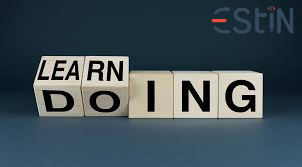
At ESTIN, learning is grounded in a fundamental principle: true understanding in IT comes not only from studying concepts, but from applying them. Mastery emerges through the systematic practice of knowledge—where theory is tested, refined, and extended through real-world application. It is through this process that abstract ideas are transformed into functional, reliable, and scalable systems.
From Theory to Practice
Conceptual knowledge provides the necessary framework for understanding computational systems. However, the ability to apply that knowledge in real-world contexts is what ultimately defines engineering competence. A theoretical understanding of algorithms, for example, must be complemented by implementation, analysis, and optimization under realistic constraints.
This transition from theory to practice is central to the learning experience, exposing students to complexities that are rarely captured in formal instruction, including incomplete specifications, performance trade-offs, and system-level interactions. Engaging with such challenges develops a rigorous and adaptive engineering mindset.
Iterative Development and Learning
The process of building systems is inherently iterative. Solutions evolve through cycles of design, implementation, evaluation, and refinement. Each iteration introduces new insights, often revealing limitations in prior assumptions or approaches.
Within this framework, errors and system failures are not anomalies but integral components of the learning process. Debugging, in particular, becomes a critical mechanism for deepening understanding, as it requires the identification and resolution of underlying system behaviors.
Systems Thinking and Problem Decomposition
Practical engagement with IT systems fosters the development of systems thinking. This involves decomposing complex problems into manageable components, understanding their interactions, and designing solutions that account for scalability, robustness, and efficiency.
Such skills are difficult to acquire through passive learning alone. They emerge through sustained engagement with real-world problems and the iterative refinement of solutions.
Bridging Knowledge and Application
The effective integration of theoretical knowledge with practical application is central to engineering education. Through this integration, abstract concepts are transformed into operational systems, and learners develop the ability to reason about both individual components and entire architectures.
This synthesis enables the transition from student to practitioner, characterized not only by technical proficiency but also by sound judgment and design capability—qualities that define the profile of ESTIN graduates.
In IT, true mastery is achieved through the continuous interplay between theory and practice. While theory provides essential foundations, it is through deliberate, hands-on application that knowledge is validated, expanded, and internalized.
This approach reflects a broader educational vision—one that emphasizes building, experimenting, and learning through action—shaping engineers capable of innovation and real-world impact.